
 ES
ES  FR
FR  EN
EN Latest From Immigria
We regularly update you on all the nuances of the immigration process, as well as life in Canada, and the US.
Study Today, Stay Tomorrow: Understanding PGWP and the Road to Canadian PR
Many international students dream of studying in Canada, and the education field has become one of the most strategic choices, especially with the new category-based immigration pathways introduced by the Government of Canada.
Teaching and early childhood education are not only in high demand across provinces but are now recognized under Canada’s category-based Express Entry selection for education occupations.
This means that completing a Post Graduation Work Permit (PGWP)-eligible education program can open the door not just to valuable Canadian work experience, but also to Permanent Residency (PR) through a targeted federal pathway.
There Is Even a Category-Based Pathway for PR for Education Occupations
Canada has recently added certain education occupations to its Category-Based Express Entry Selection. This pathway prioritizes professionals with experience in teaching and early childhood education, areas facing long-term labour shortages nationwide.
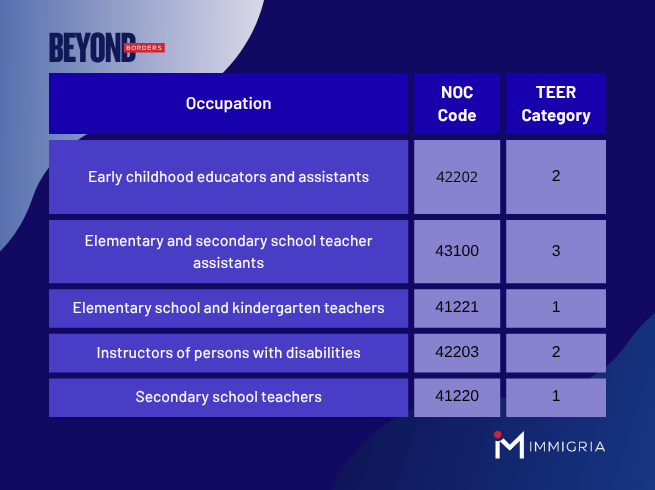
To benefit from this pathway, international graduates must first complete a PGWP-eligible education program, gain Canadian work experience in an eligible occupation, and meet the criteria under the National Occupational Classification (NOC) recognized by Immigration, Refugees and Citizenship Canada (IRCC).
What Is the PGWP and Why It Matters
The Post-Graduation Work Permit (PGWP) is an open work permit issued by Immigration, Refugees and Citizenship Canada (IRCC).
It allows international graduates from eligible Canadian institutions to work for any employer, in any province or territory, after completing their studies.
This work permit is a crucial step for many international students because it helps them gain valuable Canadian work experience, often the bridge between student life and PR.
Choosing the Right Education Program for PGWP Eligibility
1. Study at a Designated Learning Institution (DLI)
Only institutions approved by the government, called Designated Learning Institutions (DLIs), can host international students.
Even more importantly, not all DLI programs qualify for the PGWP.
Always confirm that:
-
Your college or university is on the official DLI list, and
-
Your specific program is listed as PGWP-eligible.
Examples:
-
University of British Columbia – Bachelor of Education (B.Ed.) → PGWP-eligible (up to 3 years)
-
Seneca College – Early Childhood Education Diploma → PGWP-eligible (2 years)
2. Program Length Matters
To qualify, your program must be at least 8 months long.
If it’s shorter, you won’t be eligible for a PGWP, even if the institution is a DLI.
-
Programs under 8 months → Not eligible
-
Programs of 8 months to less than 2 years → PGWP valid for the same length as your program
-
Programs of 2 years or more → PGWP valid for up to 3 years
For example, a 2-year Early Childhood Education diploma usually leads to a 3-year PGWP, giving graduates time to gain valuable Canadian experience.
3. Study Full-Time and Maintain Status
IRCC requires that students maintain full-time status throughout their studies (except for the final semester if part-time is officially allowed).
Failing to do so can make you ineligible for the PGWP, even if your program meets all other conditions.
4. Field of Study Requirement
Depending on your study program, you may need to meet a Field of Study Requirement to qualify for a Post-Graduation Work Permit (PGWP).
Most college graduates must meet this condition. To be eligible, your program must appear on IRCC’s list of approved Classification of Instructional Programs (CIP) codes at the time you submit your study permit or PGWP application.
Eligible fields of study are tied to occupations experiencing long-term labour shortages in Canada, and the list may change based on the country’s evolving labour market needs.
IRCC – Field of Study Requirement for PGWP
Understanding the CIP Code Requirement
IRCC now uses the Classification of Instructional Programs (CIP) system to determine whether a program qualifies for a Post-Graduation Work Permit (PGWP).
Each program at a Designated Learning Institution (DLI) has a unique CIP code that identifies its field of study.
Since November 1, 2024, only non-degree programs (diplomas, certificates, or other college-level studies) in eligible fields of study, those linked to occupations in long-term labour shortage areas, will qualify for the PGWP.
Degree programs (Bachelor’s, Master’s, and Doctoral) are not affected by this rule. As long as they are completed at a PGWP-eligible DLI, graduates can still apply for a PGWP.
You can review IRCC’s official list of eligible fields here:
Check IRCC’s official list of eligible fields of study.
Who Is Not Eligible for a PGWP
According to IRCC, graduates are not eligible for a Post-Graduation Work Permit if they:
-
Already received a PGWP in the past.
-
Studied English or French as a second language.
-
Took general interest or self-improvement courses.
-
Received funding from Global Affairs Canada (GAC) that requires them to return home after graduation.
-
Completed over 50% of their studies through distance learning (online or correspondence).
-
Completed a program offered by a non-Canadian institution in Canada.
-
Completed a program at a DLI that is not PGWP-eligible, including those offered through public–private partnerships (P3s) that IRCC does not recognize.
Why Teaching Programs Are a Smart Path for International Students
Education programs are some of the most strategic options for international students because they combine:
-
PGWP Eligibility
-
High demand across provinces (especially for Early Childhood Educators and ESL teachers)
-
Clear pathways to PR through the Canadian Experience Class or Provincial Nominee Programs (PNPs)
Example:
A teacher from the Philippines completes a 2-year Early Childhood Education diploma at a public college in Ontario.
She gets a 3-year PGWP, starts working full-time in a licensed childcare centre, and later applies for PR through the Ontario PNP.
Note: Some education-related professions, such as Early Childhood Educators and Assistants (NOC 42202), are regulated occupations in Canada.
This means that beyond holding a valid PGWP, graduates must obtain provincial certification or licensing before working in the field.
Requirements differ by province, for example:
-
Ontario: Registration with the College of Early Childhood Educators (CECE)
-
British Columbia: Certification through the ECE Registry
-
Alberta: Approval from the Child Care Staff Certification Office
Before choosing your program or province, make sure you understand the licensing pathway to avoid delays in starting your career.
Common Mistakes to Avoid
-
Studying at a private career college: Most are not PGWP-eligible, even if they are DLIs.
-
Choosing very short certificate programs (under 8 months): Not eligible for PGWP.
-
Assuming all education programs qualify: Always verify eligibility directly with the school or a licensed immigration consultant before applying.
What Happens After Graduation
Once you’ve completed your education program, you have up to 180 days (six months) to apply for your Post-Graduation Work Permit (PGWP).
If you are inside Canada, you must maintain valid temporary status (as a student or visitor) until you apply. Therefore 180 days rule does not apply to you and if you are inside Canada, you should submit your PGWP application before your status expires.
If you leave Canada after completing your program, you can still apply for a PGWP from abroad, as long as your application is submitted within 180 days from the date your school issues official proof of completion, such as your final transcript or completion letter.
Note: The “date of graduation” refers to when your school confirms you’ve completed your program by sharing your final grades, not the date of your ceremony.
Immigria Insight: Study Smart for Your Future
If your dream is to teach, stay, and build a career in Canada, your study plan must be strategically chosen.
A PGWP-Eligible program at a public DLI doesn’t just open the door to Canadian classrooms, it opens the door to Permanent Residency (PR).
Let Immigria Consulting Firm Guide You
At Immigria, we help international students design study paths that are PGWP-Eligible, align with their immigration goals, and meet provincial licensing requirements.
Before applying to any school, let’s make sure your education investment leads to real opportunities in Canada.
Book a consultation with our certified immigration consultants today.
Disclaimer
This blog reflects the most accurate information available as of the date of publication. Immigration laws and policies are subject to change by the Government of Canada. Always consult a licensed immigration consultant or official sources for the latest updates.