
 ES
ES  FR
FR  EN
EN Latest From Immigria
We regularly update you on all the nuances of the immigration process, as well as life in Canada, and the US.
Love Beyond Borders: Your Complete Guide to Canada’s Spousal Sponsorship Program for Permanent Residency

At Immigria Consulting Firm, we’ve seen how distance can challenge relationships, and how immigration can turn those complicated situations into new beginnings. The Spousal Sponsorship Program allows Canadian citizens and permanent residents to reunite with their loved ones and build a life together in Canada.
If you and your partner are ready to make Canada your shared home, here’s how the program works, who qualifies, and what to expect from the process.
What Is the Spousal Sponsorship Program?
Part of Canada’s Family Class Immigration, the Spousal Sponsorship Program enables a Canadian citizen or permanent resident to sponsor their spouse, common-law partner, or conjugal partner to become a permanent resident. Please note that Canada fully recognizes and provides equal rights to individuals in same-gender relationships
There are two classes under which you can apply:
-
In-Canada Class (Inland Sponsorship): Your partner is already in Canada on valid status. While waiting for a decision, they may be eligible for an open work permit.
-
Family Class (Outland Sponsorship): Your partner lives abroad and the application is processed through a visa office outside Canada.
Each year, Canada welcomes thousands of new permanent residents through the Family Class, making spousal sponsorship one of the country’s largest and most compassionate immigration pathways.
Understanding the Relationship Categories
-
Marriage: A legally recognized union between two people, valid under the laws of the country or province where it took place.
-
Common-law partner: You and your partner have lived together in a committed, marriage-like relationship for at least 12 consecutive months.
-
Conjugal partner: This applies only in extraordinary situations, when you’ve been in a genuine, exclusive relationship for at least 12 months but cannot live together or marry due to serious barriers such as immigration restrictions, same-sex marriage bans, or cultural or religious limitations.
-
You must prove that your relationship is as committed and exclusive as a marriage or common-law union.
-
Open or non-exclusive relationships are not eligible.
-
This category is rarely approved and used only when there is clear, documented evidence that living together or marrying was impossible.
-
At Immigria Consulting Firm, we help our clients identify which category truly fits their situation, because choosing the wrong one can cause delays or even refusals.
Why the Process Is So Detailed
Over time, some individuals have attempted to misuse this pathway through false or convenience marriages. Because of this, IRCC applies strict standards and carefully reviews every relationship to confirm that it’s genuine and long-term.
While the application may seem extensive, it’s designed to protect the integrity of Canada’s immigration system, and genuine couples have nothing to worry about when their story is well-documented and clearly presented.
Open Work Permit Options
Your partner may be eligible for an Open Work Permit (OWP) while their Permanent Residency (PR) application is being processed, and recent updates have made this more flexible.
-
Inland applicants can apply for an OWP even before receiving the Acknowledgment of Receipt (AOR), provided they’ve submitted a complete sponsorship application and hold valid status in Canada, which is expiring within two weeks.
-
Outland applicants may also apply for an OWP, in case they come to Canada and holds a valid status.
Because OWP policies can change, it’s important to check the latest IRCC updates or consult a certified immigration consultant before applying.
At Immigria, we help couples determine the best strategy, whether applying for a work permit first or waiting for PR approval, based on their specific circumstances.
Step-by-Step: How the Process Works
Step 1: Confirm Eligibility
The sponsor must be at least 18 years old, a Canadian citizen or permanent resident, and able to financially support their partner for three years after PR is granted.
Step 2: Choose the Right Stream
Select the appropriate class, Inland or Family Class (Outland), depending on your partner’s current location.
Step 3: Prepare the Application Package
Include all forms, proof of relationship, identity documents, police certificates, medical exams, and government fees. Accuracy and consistency are key; even small errors can delay the process.
Step 4: Submit and Wait for Processing
All applications are filed online through IRCC’s secure portal.
Processing times vary depending on whether the couple lives inside or outside Canada, and whether they are located in Quebec or elsewhere.
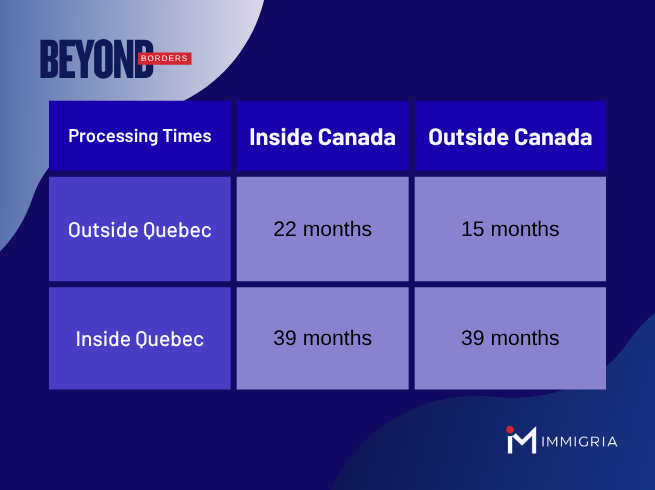
Source: IRCC processing times, updated October 9, 2025
While these timelines may vary depending on IRCC’s workload and the completeness of your file, they provide a realistic overview of what to expect.
If your partner is already in Canada with a valid status, they may apply for an open work permit while waiting for the decision, allowing them to live and work legally during processing.
At Immigria Consulting Firm, we monitor IRCC’s processing trends closely and guide our clients on how to prepare complete, accurate applications that avoid unnecessary delays.
Step 5: Approval and Permanent Residency
Once approved, your partner becomes a permanent resident and can begin their new chapter in Canada.
Sponsorship in Quebec
Quebec operates under its own immigration system, and the process differs slightly from the rest of Canada. In addition to federal level application, Quebec applicants must submit an additional undertaking application to MIFI (Ministère de l’Immigration, de la Francisation et de l’Intégration) when invited by IRCC.
-
No French language proficiency is required for the sponsor or applicant, but there is an expectation to commit to French integration at the time of application.
-
The undertaking period in Quebec is generally three years, similar to the rest of Canada.
IMPORTANT : Currently, the sponsorship undertaking process is temporarily suspended until June 25, 2026, after reaching its intake cap.
Our team at Immigria can help you navigate these unique Quebec requirements to ensure your application remains valid and on track when processing resumes.
Common Mistakes to Avoid
Even genuine couples face refusals when small details are missed. The most frequent mistakes include:
-
Incomplete or inconsistent forms and documents
-
Weak or unclear relationship evidence
-
Missing translations for non-English or non-French documents
-
Paying incorrect government fees
-
Choosing the wrong class (inland vs. outland)
Having a certified consultant review your file can make the difference between months of delay and a smooth approval.
How to Prove a Genuine Relationship to IRCC
IRCC officers assess every application carefully to ensure the relationship is authentic and not entered into for immigration purposes. To prove yours is genuine:
-
Provide consistent communication records (messages, call logs, travel history).
-
Include photos showing your relationship over time.
-
Demonstrate shared responsibilities (joint leases, bank accounts, bills).
-
Add personal statements explaining your journey and future plans.
-
Include letters from family or friends supporting your relationship.
It’s not about the number of documents, but the clarity and authenticity of your story.
At Immigria, we help clients present strong, credible evidence that truly reflects their relationship and meets IRCC’s standards.
Why Choose Immigria Consulting Firm
We’ve successfully guided many couples through Canada’s Spousal Sponsorship process. Our certified immigration consultants understand every IRCC requirement and ensure your file is prepared with care, precision, and professionalism.
At Immigria Consulting Firm, we treat every case as personal. Our goal is to help families reunite, ensuring every detail is right the first time.
Ready to Reunite in Canada?
If you and your partner are ready to begin your life together in Canada, Immigria is here to help.
Our team will ensure your application reflects your genuine relationship and meets every IRCC requirement.
Book your consultation today, and take the first step toward your future together:
Disclaimer
This blog reflects the most accurate information available as of the date of publication. Immigration laws and policies are subject to change by the Government of Canada. Always consult a licensed immigration consultant or official sources for the latest updates.